Soffit & Fascia in Edmonton
The roof edge that carries the eavestroughs and supplies every bit of intake air your attic gets.
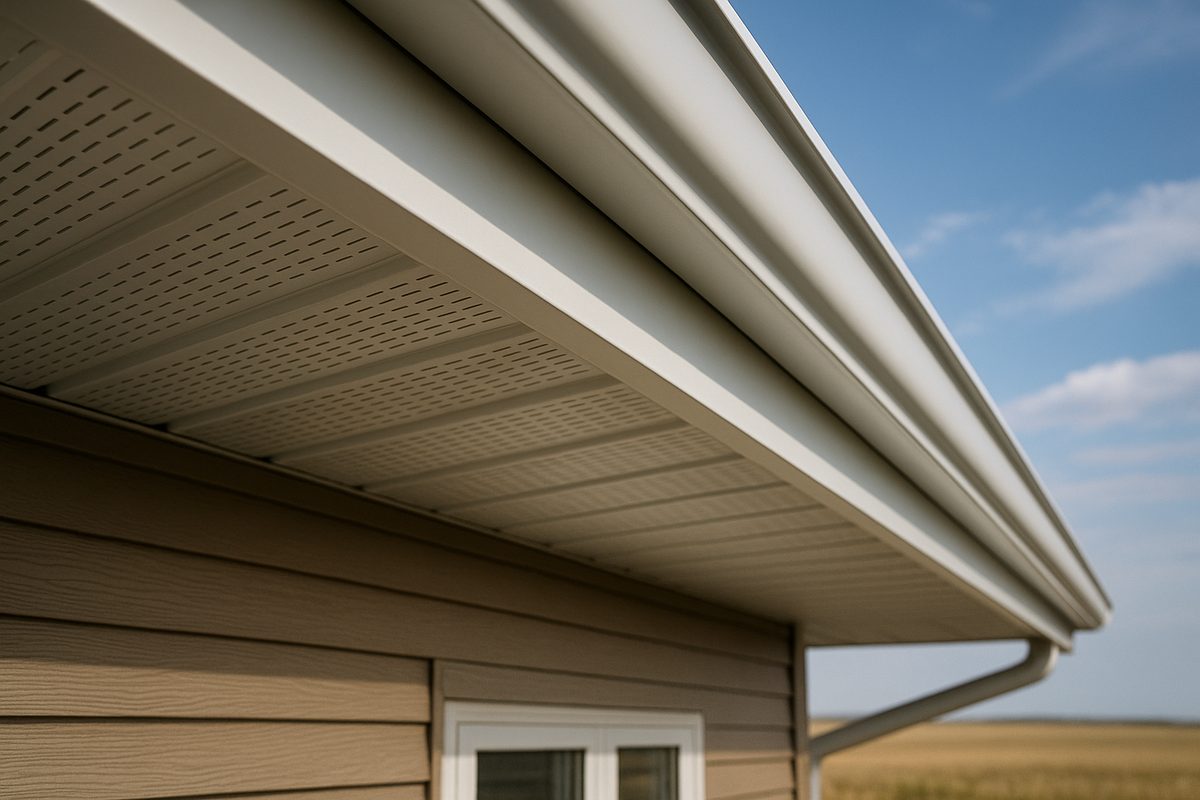
Soffit and fascia are the parts of a roof most people only think about when the paint fails or a squirrel gets in. Edmonton Roof Pros treats them as part of the roof system, because they are. The fascia carries the eavestroughs that keep water off your walls and away from the foundation, and the soffit is where every bit of intake air your attic gets comes from.
Fascia: Where Water Damage Starts
Fascia is the board running horizontally along the roof edge, and it is where the eavestroughs are fastened. That makes it the part of the roof edge most exposed to water, and the part where problems compound quietly.
When an eavestrough overflows, sags, back-slopes or leaks at a seam, the water it should be carrying away runs down behind it instead, straight onto the fascia. Wood fascia under those conditions goes soft, then rots, then loses the ability to hold the trough fasteners. Now the trough sags further, which makes the overflow worse.
So we look at the trough and the fascia together. Replacing rotten fascia without correcting the drainage that rotted it is a repair with a short life.
Where rot has gone further, the sub-fascia and rafter tails behind the visible board can be affected too. Those get repaired before anything is clad over them, because aluminium fascia capping installed over rotten wood hides the problem rather than solving it, and it will keep progressing out of sight.
Soffit: The Attic’s Air Supply
The soffit is the panel sealing off the open underside of the overhang, and its perforations are where every cubic foot of attic air starts out.
This is where soffit work stops being cosmetic. An attic needs air entering low at the eaves and leaving high at the ridge. If the soffit is solid, or if the vented panels are there but blocked from inside by blown-in insulation pushed over the top plate, there is no intake. The exhaust vents at the top then draw air from the house below instead, pulling heated humid air into the attic and making condensation and ice damming worse.
So when we replace soffit we confirm the vented area is adequate for the roof, and we check from inside that the path is actually clear. Where insulation has sealed the eaves, baffles go in to hold an open channel. Our roof ventilation page explains why balance matters more than raw vent count.
Doing It With the Roof
The economics strongly favour doing this work during a roof replacement. The eavestroughs come off for a re-roof anyway, the roof edge and drip edge are being renewed, and the crew is already set up at height with the right access.
Doing soffit and fascia as a separate project later means paying again for that access and disturbing a roof that has just been finished. When we quote a re-roof, we will tell you honestly what condition the edge is in and whether it is worth including now, or whether it has years left and should be left alone.
What's Included
- Aluminium and vinyl soffit with adequate vented area
- Fascia replaced where rot has taken hold behind the eavestrough
- Rotten sub-fascia and rafter tails repaired before cladding
- Intake ventilation restored, not just covered over
- Coordinated with a re-roof so the edge is done once
Other Services We Offer in Edmonton
Soffit & Fascia Questions
Which one is the soffit and which is the fascia?
The fascia is the upright board capping the ends of the rafters, and the eavestroughs bolt to it. The soffit is the flat panel bridging from that board back to the wall. Fascia deals with water; soffit deals with air.
Why does my fascia keep rotting?
Usually because the eavestrough behind it is failing. An overflowing, back-sloped or leaking trough sends water directly against the fascia every time it rains, and no paint survives that indefinitely. Replacing the fascia without fixing the trough means doing the same job again.
Do I need vented soffit everywhere?
You need enough vented area to balance the exhaust at the top of the roof, and it needs to be distributed along the eaves rather than concentrated in one place. Fully vented soffit along the whole run is the usual approach because it is simple and it guarantees the area.
Is soffit and fascia work worth doing at the same time as the roof?
Nearly always. The eavestroughs are already coming off, the roof edge is exposed, and the crew is on site with the right equipment. Doing it separately later means paying twice for the same access.
Can you match my existing colour?
Usually closely, though an exact match to material that has been weathering for twenty years is not always possible. Where a partial replacement would look obviously patched, we will say so and price doing the full run.
Get a Free Soffit & Fascia Quote
Book a free quote. We will tell you which one it is, in writing, before you spend anything.