
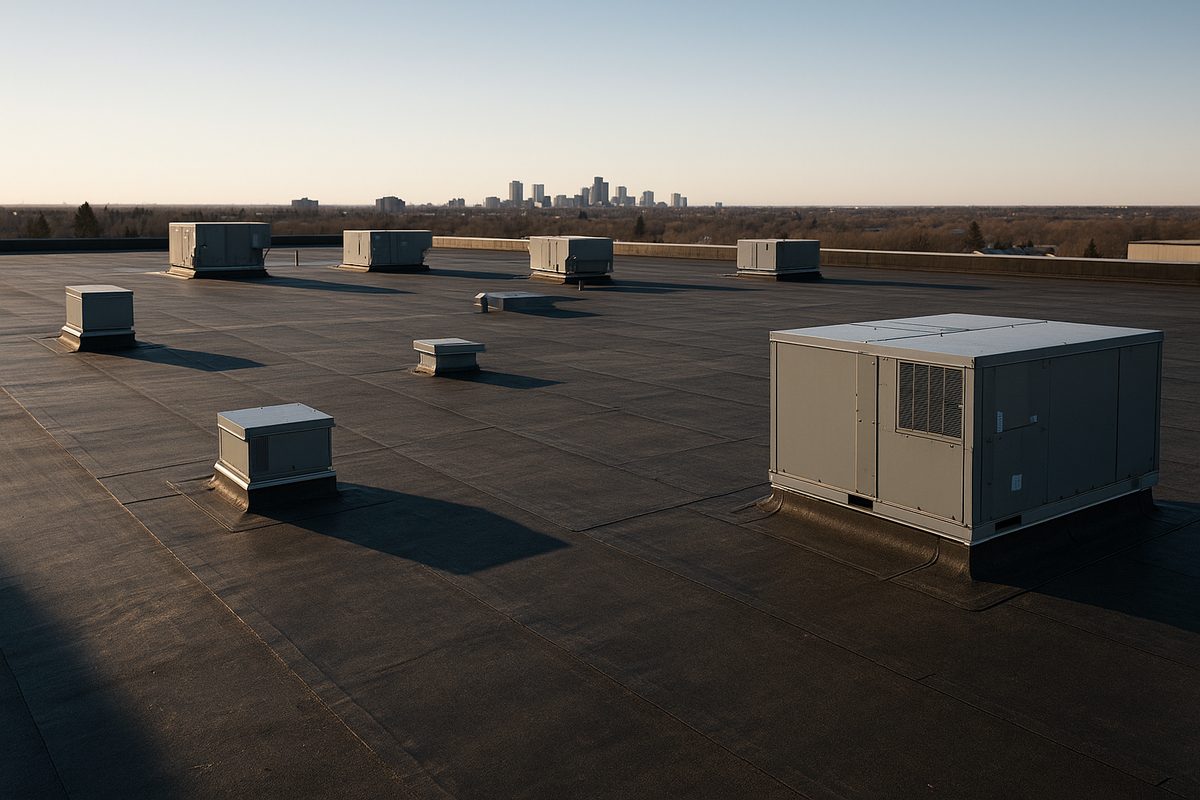
Commercial Roofing in Edmonton
Membrane roofing for commercial and multi-unit buildings, scheduled so the business underneath keeps running.
A commercial roof is a business asset with a replacement cost measured in tens of thousands of dollars, and it usually gets ignored until it interrupts operations. Edmonton Roof Pros works on commercial membrane roofs across the city. The difference between a roof that lasts its full service life and one that fails early is rarely the membrane. It is drainage, detailing around penetrations, and whether anyone looked at it between installation and the first leak.
Systems for Commercial Decks
Torch-on SBS modified bitumen remains the workhorse for commercial buildings in this region. Two plies, heat-applied, producing a thick and repairable membrane that tolerates rooftop foot traffic from mechanical servicing.
EPDM offers large sheets with few field seams and excellent cold flexibility, which suits our winters. TPO welds its seams with heat rather than adhesive and reflects more summer heat off the building.
Many older Edmonton buildings still carry built-up tar and gravel assemblies. Those can often be repaired for years, and when they do come off, the tear-off is a bigger job than a single-ply removal, which is worth knowing at budget time rather than at quote time.
Where Commercial Roofs Actually Fail
Almost never in the middle. Failures concentrate at the interruptions: curbs under mechanical units, vent and exhaust penetrations, drains, parapet bases, and expansion joints.
Rooftop equipment is the largest single source. A unit that was serviced by someone who walked on the membrane in cold weather, or a curb flashing that was cut and resealed rather than rebuilt after a unit change, leaves a path for water directly above whatever is below it. When we quote a commercial roof, the curb and penetration details are itemised, because that is where the money either gets spent properly or gets spent again in four years.
Drains are the other one. A blocked or badly positioned drain turns a flat roof into a shallow pond, and standing water in this climate freezes, expands and works at every seam it touches. Our flat roofing page goes into drainage in more detail.
Working Around Your Operations
Commercial work is a scheduling problem as much as a roofing one. We stage in sections so the building is weathertight at the end of each day rather than opened up across a whole roof.
Where torch-on work runs near fresh-air intakes, that gets planned in advance so odour does not arrive inside the building during business hours. Access routes, parking, crane or hoist placement and debris containment all get agreed before the crew arrives, because a roofing project that blocks the loading door on a delivery morning costs the tenant more than the roof.
For multi-unit residential buildings, tenant notification and access are the equivalent consideration, and we will give you what you need to send out in advance.
Planning Rather Than Reacting
The most useful thing we do for building owners is not replacement, it is telling them accurately how long they have. A condition report with photographs and a remaining-life estimate lets a roof become a planned capital item instead of an emergency, and it lets small repairs happen while they are still small.
If a leak is active now, emergency roof repair is the immediate step. If you want to know where the roof stands before budgeting, start with a roof inspection.
What's Included
- Torch-on, EPDM and TPO systems for commercial decks
- Work staged around business hours and tenant access
- Roof-top unit curbs, vents and penetrations detailed properly
- Condition reports and multi-year budget planning
- Repairs and maintenance programmes as well as replacement
Other Services We Offer in Edmonton
Commercial Roofing Questions
How long does a commercial roof last?
A well installed membrane system on a properly drained deck generally gives twenty years or more, and the spread is driven far more by drainage, detailing and maintenance than by which membrane was chosen. Roofs that fail early almost always do so at curbs, penetrations and drains rather than in the open field.
What is a commercial roof actually called?
The common systems are described by their membrane. Torch-on or SBS modified bitumen is a two-ply asphaltic system applied with heat. EPDM is a rubber single-ply. TPO is a heat-welded thermoplastic single-ply. Built-up roofing is the older multi-layer tar and gravel assembly still found on many existing buildings.
Can you work without shutting down the business?
Almost always. We stage the work in sections so the building stays weathertight overnight, plan noisy and odorous phases around your hours where possible, and keep access routes clear. Torch-on work needs particular coordination near air intakes, which we plan around rather than discover on the day.
Do you handle roof-top HVAC units and other equipment?
We handle the roofing side, which means the curbs, flashing and membrane terminations around each unit. Those interfaces are where a great many commercial leaks originate. Mechanical disconnection and reconnection is a trade coordination item and we tell you clearly where our scope ends.
Can you assess a roof before we buy the building?
Yes, and it is worth doing. A condition report on a commercial roof tells you whether you are inheriting a near-term capital expense or a roof with a decade left, which is material to what the building is worth.
Get a Free Commercial Roofing Quote
Book a free quote. We will tell you which one it is, in writing, before you spend anything.