
Chimney & Flashing Repair in Edmonton
Rebuilding the metal details around chimneys, walls and skylights, which is where most roofs actually leak.
If a roof leaks, the odds strongly favour a flashing failure over a shingle failure, and it is the repair Edmonton Roof Pros is called out for most often. Shingles have an easy job: shed water travelling downhill across an uninterrupted plane. Flashing has the hard job, which is keeping water out everywhere that plane is interrupted.
Chimneys are the hardest case of all, because they combine a large interruption, a rough masonry surface, and two materials that expand and contract at different rates in a climate with an enormous annual temperature range.
How Chimney Flashing Should Be Built
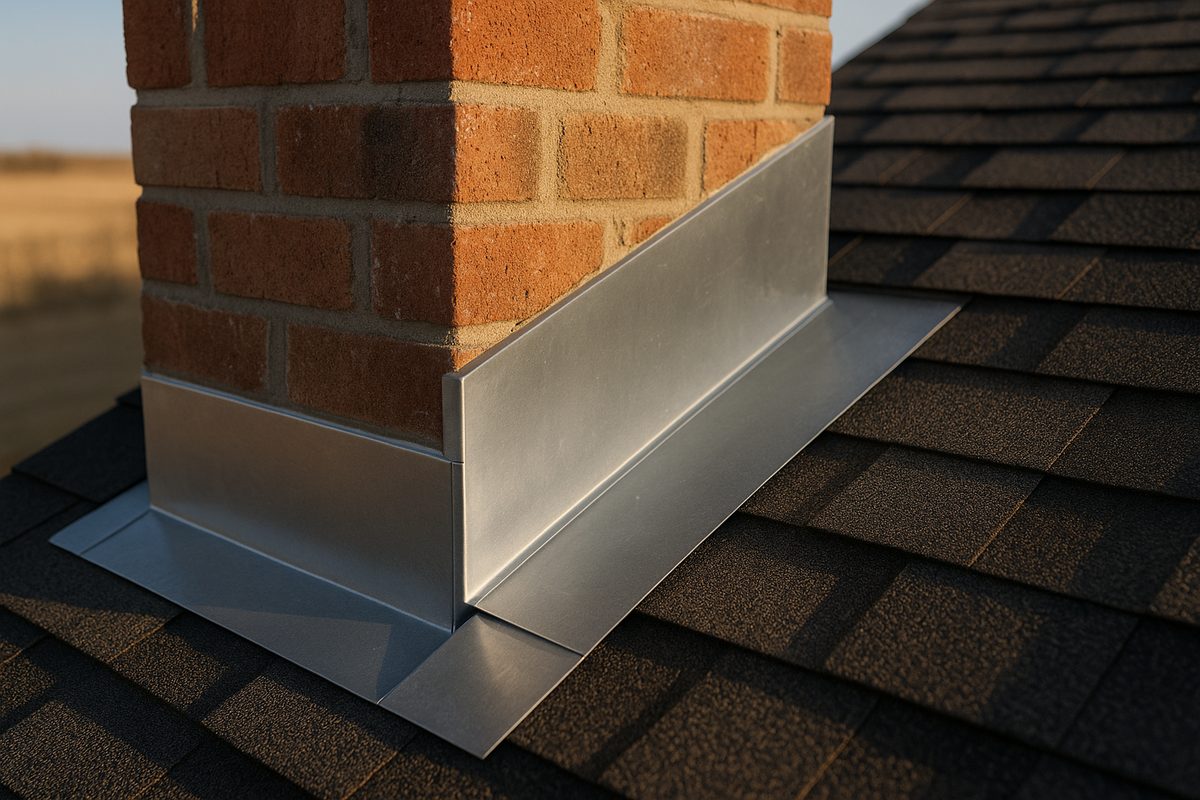
Proper chimney flashing is two separate layers working together.
Step flashing goes in first, one piece per shingle course, each piece bent up the chimney face and lapped by the course above. It is woven into the roof as the shingles go on, so water running down the roof is carried out over the shingle surface rather than in behind it.
Over that sits the second layer, and this is the part most often skipped. A channel gets cut into a mortar course, the metal is set into it, and its lower edge hangs loose over the step flashing beneath. Nothing is glued. Water arriving down the brick face has no route except outward onto the shingles, and because the two layers are never fastened to each other, the masonry and the roof can move all winter without opening a path.
What we frequently find instead is counter-flashing surface-mounted to the brick and sealed with caulk, or no counter-flashing at all and simply a heavy bead of sealant. Both fail, and both fail in a way that puts water directly into the roof deck beside the chimney, where it is hidden until it has done real damage.
Crickets
Any chimney broad enough to interrupt the slope creates a trap on its uphill face. In a milder climate that trap drains and nobody notices. Here it fills with snow in November and is still holding meltwater in March, so the sheathing behind the masonry spends a third of the year damp even though the roof around it is sound.
The remedy is framed rather than flashed: a small ridged structure built into that dead space so the plane sheds in two directions and never presents a flat surface for snow to sit on. On older houses with broad brick stacks, adding one during a repair frequently ends a leak history that years of resealing never touched.
Walls, Skylights and Stacks
The same principles apply everywhere the roof meets something vertical. Step flashing into a sidewall on an addition or split-level transition is one of the most common repairs we do, particularly where a previous re-roof bent the old flashing back into place and nailed the shingles over it.
Skylight curbs need head flashing, step flashing along the sides and apron flashing at the base, all integrated with the courses in the correct order. Plumbing stack boots perish from UV and cold cycling well before the shingles do, and a cracked boot is a straight path into the deck.
If you have an active leak and are not sure where it is coming from, roof leak repair explains how we trace it. If the roof is broadly at the end of its life, addressing flashing on its own is not the right spend, and roof replacement covers renewing every detail at once.
What's Included
- Counter-flashing cut into the mortar joint, not caulked over
- Step flashing renewed course by course, never reused
- Crickets built behind wide chimneys to divert water
- Skylight curb and head flashing rebuilt
- Masonry condition assessed and reported honestly
Other Services We Offer in Edmonton
Chimney & Flashing Repair Questions
Why does my chimney leak when the roof around it is fine?
Because a chimney is a hole through the roof with a masonry structure sitting in it, and everything depends on the metal detailing that bridges the two. Shingles have a straightforward job. Chimney flashing has to shed water arriving from above, seal against a rough masonry face, and accommodate two materials moving at different rates.
The last roofer just ran sealant along the chimney. Is that a repair?
It is a delay, not a repair. This city puts about eighty degrees between its coldest night and its warmest afternoon, and brick and sheet metal do not expand at the same rate across that span. Any joint whose watertightness depends on a bead staying bonded to both materials will open. A proper detail keeps water out by shape rather than adhesion, which is why it survives the movement.
My chimney has a flat spot behind it that stays wet. What is that?
That is the up-slope face doing what it does on any chimney wide enough to block the flow, and in this city it matters more because snow parks there for months rather than draining away in a day. The fix is a saddle framed in behind the masonry so the roof plane never presents a flat catchment in the first place. Plenty of Edmonton chimneys were built without one, and they are reliably the ones we get called back to.
My chimney is not used any more. Can it just be removed?
Often yes, and it can be the cheapest permanent answer. If the chimney serves nothing, removing it above the roofline and roofing over the opening eliminates the maintenance point entirely. We will tell you when that is the sensible option instead of repairing something with no function.
Do you repair the masonry too?
We assess it and report on it honestly, and we handle the roofing interface. Significant repointing or a rebuilt chimney crown is masonry work, and we will tell you plainly when that is what the situation actually needs rather than roofing over a structural problem.
Get a Free Chimney & Flashing Repair Quote
Book a free quote. We will tell you which one it is, in writing, before you spend anything.