
Flat Roofing in Edmonton
Membrane roofing for flat and low-slope surfaces, where drainage and detail work matter more than the material choice.
Flat roofs fail differently to pitched ones, and Edmonton Roof Pros approaches them as a drainage problem before a membrane one. A pitched roof sheds water by geometry, so a small imperfection often gets away with it for years. A flat roof holds water anywhere it is not properly drained, and every seam, curb and penetration is a place where a small mistake becomes a leak.
That is why on a flat roof the material choice matters much less than most people expect, and the drainage design and detail work matter much more.
The Systems We Install
Torch-on SBS modified bitumen is the most widely used system in this region. It is applied in two plies, with the cap sheet torched down to the base, and it produces a thick, hard-wearing membrane that handles foot traffic and cold weather well. Repairs are straightforward, which matters over a twenty-year life.
EPDM is a synthetic rubber membrane, usually installed in large sheets so there are few seams. It stays flexible at low temperatures, which suits a climate that swings hard across the winter, and its main watch point is the seams and terminations rather than the field.
TPO is a single-ply membrane whose seams are heat-welded rather than glued, producing a strong continuous joint, with a reflective surface that keeps the assembly cooler in summer.
We will tell you which makes sense for your building rather than defaulting to one. Deck type, existing assembly, roof traffic, and whether there is mechanical equipment up there all factor into it.
Drainage Is The Whole Job
A flat roof is never actually flat. It is built with a deliberate slope toward drains or scuppers, and everything depends on water reaching them.
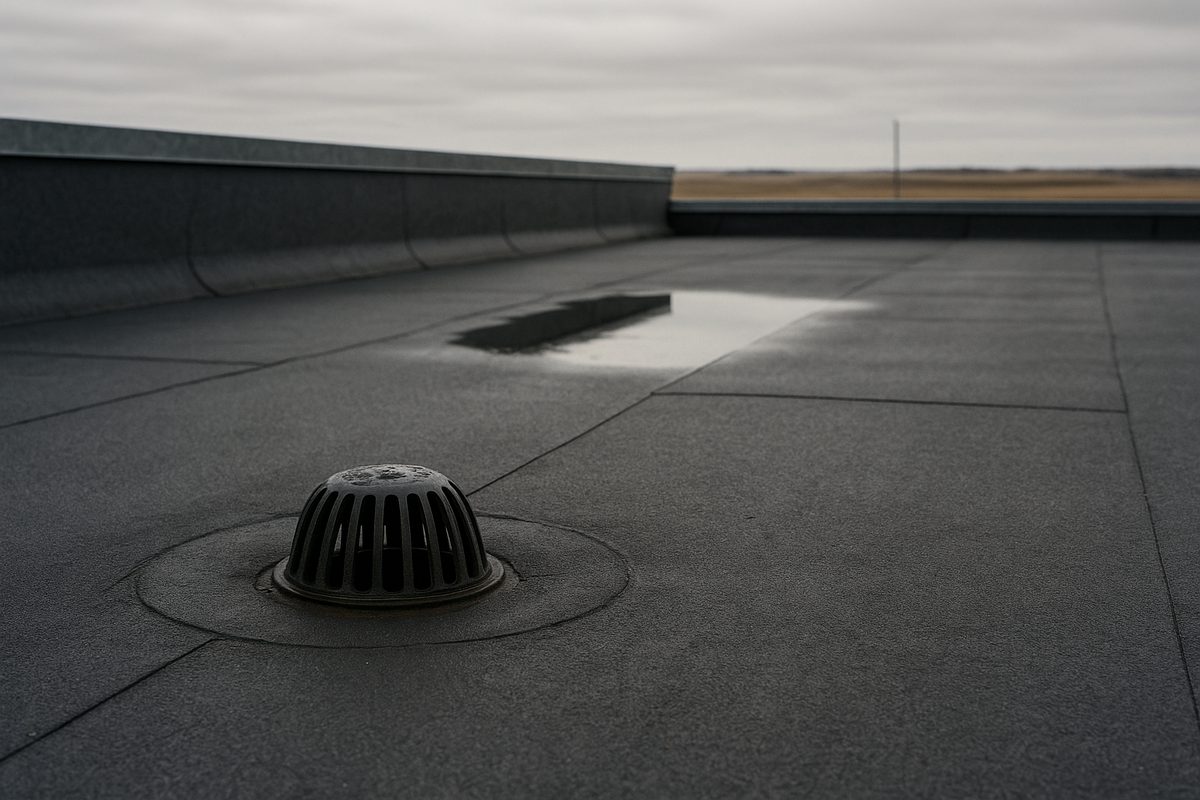
When we assess a flat roof, we look at where water is actually going, not where the drawings say it should. Ponding marks are obvious after rain and still visible as staining once dry. If the deck has deflected between joists over the years, or an addition changed the drainage pattern, or a drain sits slightly high, water sits. Sitting water shortens membrane life, adds weight to the structure, and in this climate freezes and thaws repeatedly in place.
Correcting slope with tapered insulation, relocating or adding drains, or rebuilding a scupper is often the difference between a flat roof that lasts and one that gets re-covered every few years.
Snow, Ice and Winter
A flat roof does not shed snow. The load accumulates and stays until it melts, so drains have to be clear and correctly placed or the meltwater has nowhere to go. Water that pools and refreezes at a drain is one of the more common winter problems we see on flat roofs here.
Parapets add another consideration, because snow drifts against them and the flashing at the parapet base is a demanding detail that has to be watertight while accommodating movement.
Low-Slope Sections on Houses
Plenty of Edmonton houses have a flat or low-slope section — over an addition, a garage, a porch or a dormer — and these produce a disproportionate share of residential leaks. The reason is almost always the transition where the pitched roof meets the low-slope section, which needs the membrane carried up under the shingle courses properly rather than sealed at the joint.
If you have a leak in a room under a flat section, roof leak repair covers how we trace it. For a commercial building, commercial roofing covers the larger-scale version of this work.
What's Included
- Torch-on SBS modified bitumen, EPDM rubber and TPO systems
- Drainage assessed and corrected, not just re-covered
- Parapet, curb and penetration detailing done properly
- Tear-off to deck where the existing assembly is saturated
- Low-slope residential sections and garage roofs included
Other Services We Offer in Edmonton
Flat Roofing Questions
Which flat roof membrane is best here?
Each has a place. Torch-on SBS is the most common choice locally, handles foot traffic and cold well, and repairs easily. EPDM rubber is durable and flexible in cold, with seams as the main watch point. TPO is a heat-welded single ply with strong seams and a reflective surface. The system matters far less than whether the drainage and detailing are right.
Why does my flat roof pond water?
Because it is not truly flat and never was. A flat roof is built with a slight slope toward drains, and ponding means either the slope was inadequate, the deck has deflected over time, or the drains are blocked or badly positioned. Water sitting on a membrane shortens its life and adds weight, so ponding is worth fixing rather than tolerating.
Can a flat roof handle Edmonton snow loads?
Yes, when it is built and drained for it. Flat roofs do not shed snow the way a pitched roof does, so the load sits until it melts, and meltwater has to reach a drain rather than pool and refreeze. Drain placement and keeping them clear matters more here than in a milder climate.
Can you repair a flat roof or does it need full replacement?
Localised failures at a seam, a curb or a penetration are genuinely repairable. What is not worth repairing is a membrane with saturated insulation underneath, because water trapped in the assembly keeps working regardless of what is patched over it. We probe for that before recommending either.
Do you do garage and addition roofs?
Yes. Low-slope sections on houses, over additions, garages and porches are common in Edmonton and they are one of the more frequent sources of leaks, because the transition from the pitched roof to the flat section is a demanding detail.
Get a Free Flat Roofing Quote
Book a free quote. We will tell you which one it is, in writing, before you spend anything.