
Roof Leak Repair in Edmonton
Tracing a leak back to where water actually enters, and repairing the detail that let it in.
A leaking roof is the one roofing problem that gets worse quickly, which is why Edmonton Roof Pros treats leak calls as time-sensitive. Water in a deck does not stay in the deck. It moves into insulation, framing and drywall, and a small entry point that would have been an inexpensive repair in September can be a much larger one by spring.
Finding the Entry Point
We do not start in the room with the stain. Water enters high and exits low, following the underside of the sheathing and the sides of rafters until something stops it, so the visible damage is a poor guide to the source.
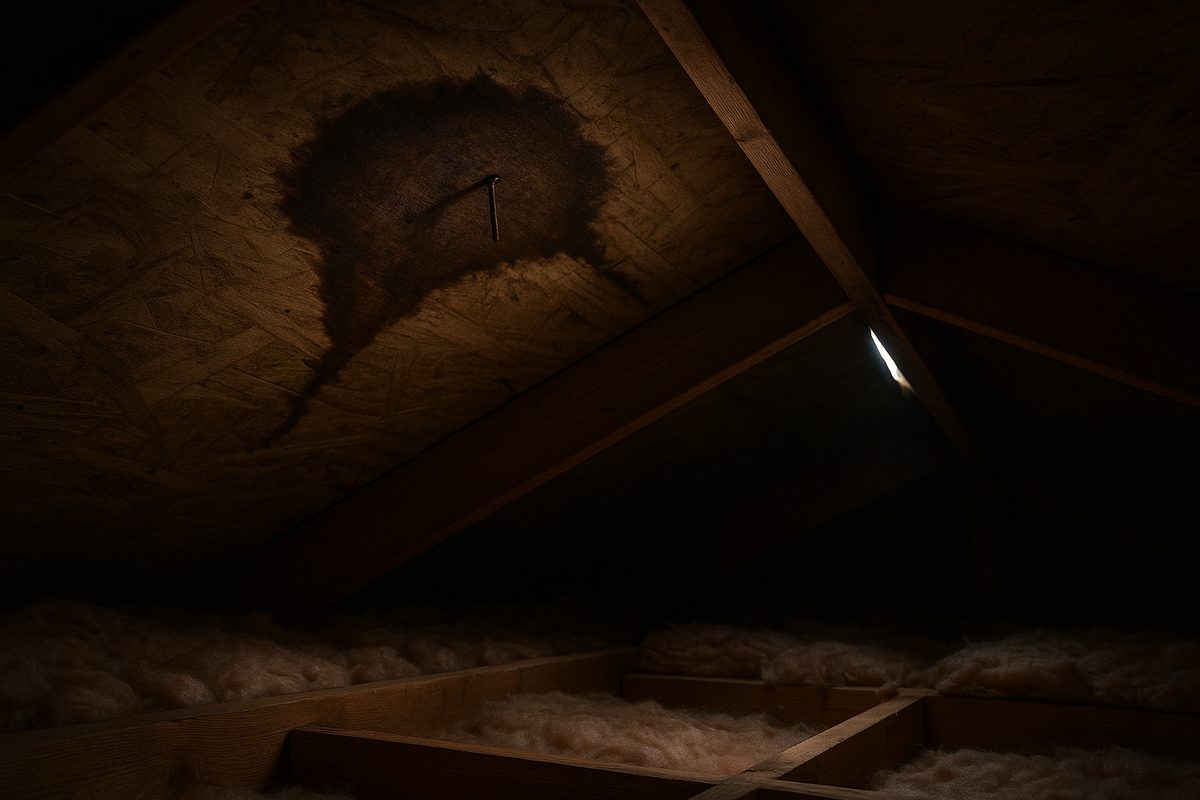
The attic tells the real story. Darkened or stained sheathing, rusted nail shanks, compressed and matted insulation, and daylight visible at a joint all trace back toward where water is coming in. We follow that path uphill to the roof, then look at what is actually there: a wall intersection, a stack, a valley, a skylight curb, a chimney.
The weather that produces the leak narrows it further. A leak that appears only in driving rain is a flashing problem. A leak that appears during a thaw after a cold snap is ice damming. A leak that appears in any rain at all is usually a straightforward penetration failure. Knowing which one you have before going up saves opening the wrong thing.
What Usually Fails
Plumbing stack boots are the single most common source we find. The rubber collar around the pipe perishes from UV and cold cycling well before the shingles around it are finished, and once it cracks the water goes straight into the deck.
Step flashing where a roof plane meets a wall is next, particularly on additions and split-level transitions where two rooflines meet at an awkward angle. Flashing that was bent back and reused during a previous re-roof rarely seals properly the second time.
Valleys concentrate more water than any other part of a roof and take the worst of the ice loading. Skylight curbs and chimney counter-flashing round out the list. On older brick chimneys, counter-flashing needs to be cut into the mortar joint, and a bead of caulk over the top of it is a repair that reappears within a couple of seasons.
Repairing It Properly
Once we find the source, wet sheathing comes out. Covering damp decking with new material traps the moisture and guarantees a return visit, so anything soft or delaminated gets replaced back to sound material.
Then the failed detail gets rebuilt rather than sealed. Sealant has a place as a supplementary measure, but a flashing repair that depends on a bead of caulk to stay watertight is a repair with a two-year clock on it. New flashing, correctly lapped and integrated with the courses above and below, is what makes it last.
When Repair Is Not the Answer
If we find that the field is broadly at the end of its life, with granules gone, edges cracking and multiple entry points, we will tell you that a repair is buying a season and walk you through roof replacement instead. Equally, if it is one failed boot on an otherwise sound roof, we will fix the boot and leave the rest alone.
Water coming in right now and you need it stopped today? See emergency roof repair. If the leak shows up during thaws, ice dam removal covers the cause.
What's Included
- Attic inspection to trace the water path back to entry
- Flashing, boot, valley and skylight repairs
- Wet or delaminated sheathing replaced, not covered over
- Written explanation of what failed and why
Other Services We Offer in Edmonton
Roof Leak Repair Questions
Why is the water stain nowhere near a roof feature?
Because water travels. It gets in high, tracks along the underside of the sheathing or down a rafter face, and falls wherever something breaks its path, whether a joint, a nail or a run of strapping. The drip can land metres from where it entered. Patching directly above the stain is the most common way a leak repair fails.
My roof only leaks in heavy wind-driven rain. Why?
That pattern almost always points to flashing rather than the shingle field. Vertical rain lands on the roof and runs off. Wind-driven rain gets pushed sideways and upward, in behind flashing, siding and drip edge, into gaps that ordinary rain never reaches.
It only leaks during a thaw, not when it rains. What does that mean?
That is the classic ice damming signature. Snow on the warm upper roof melts, runs down to the cold overhang, refreezes, and builds a dam. Water pools behind it and backs up underneath the shingle courses, which are designed to shed water downhill, not to hold it. The fix involves ventilation as much as roofing.
Can a leak be fixed in winter?
We can usually stop water entering as a temporary measure. A permanent repair often needs conditions that let sealants cure and shingles seal, so we are honest about what is temporary and come back to finish it properly.
How much does leak repair cost?
It depends entirely on what failed and how much wet decking is behind it. A perished plumbing boot is a small job. A valley that has been quietly wetting the deck for three winters is a larger one. We give you the price in writing after we find the source, not before.
Get a Free Roof Leak Repair Quote
Book a free quote. We will tell you which one it is, in writing, before you spend anything.